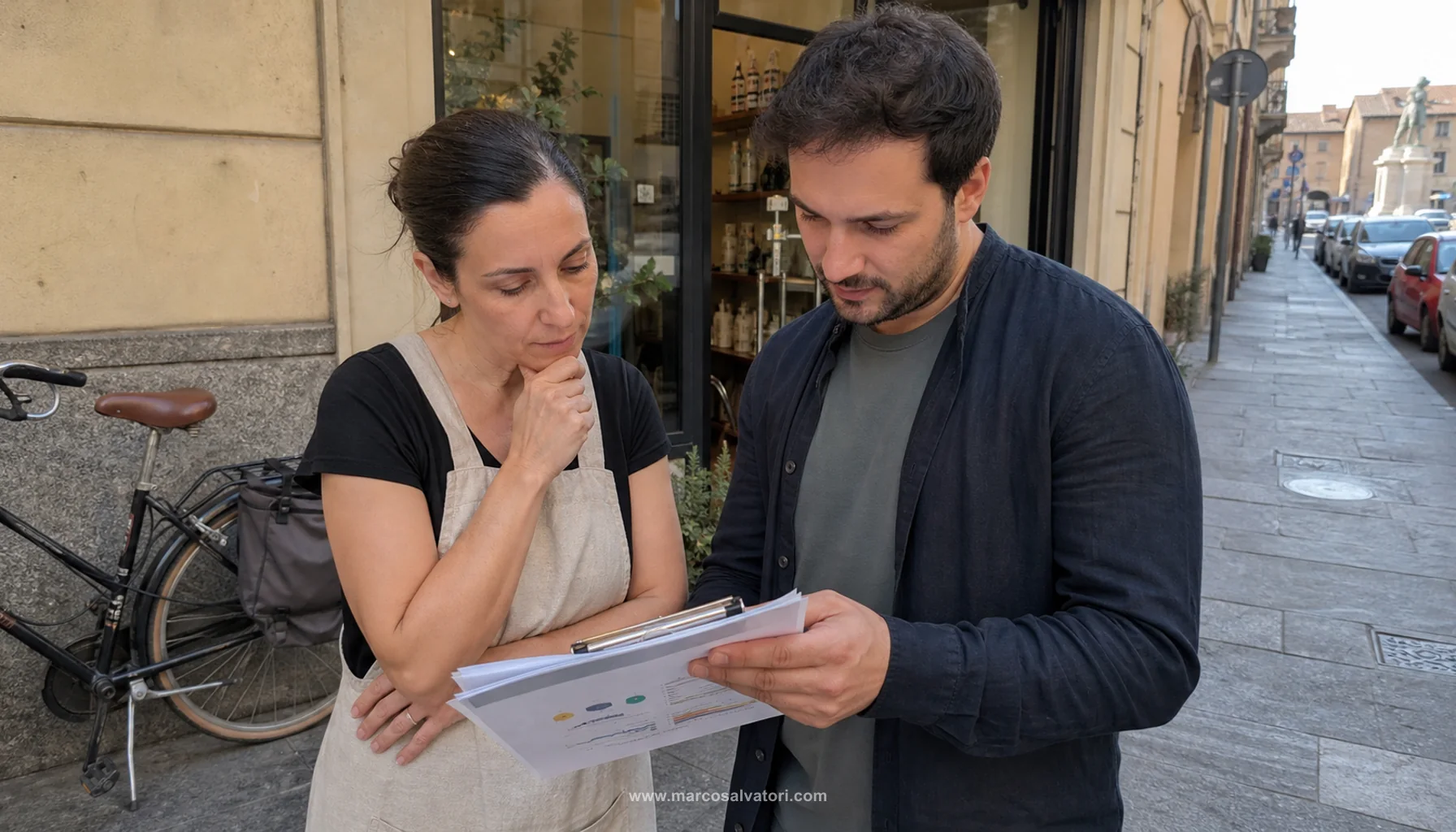


Local SEO is not the practice of repeating “Piacenza” in every heading or creating a near-identical page for each town. Its purpose is to make a real relationship understandable: what a business offers, where it operates, which needs it addresses and why someone should choose it. When the website, Google Business Profile and public information describe the same reality, people can make a decision with less friction.
This guide presents an operational method rather than another definition. It starts with the journey from a local search to a useful action: visiting a location, calling, requesting directions, booking or sending an enquiry. Every improvement should be evaluated against that journey.
Understand when a search is genuinely local
Queries containing a city do not all express the same intent. Someone looking for a service in Piacenza may need a nearby physical presence, a professional familiar with the area or a company able to work in a defined service area. In other cases proximity matters little, and forcing it into the content makes the page less useful.
For each service, identify what genuinely helps people decide: location and opening hours, service area, appointment options, relevant examples, response process or remote availability. These details should be easy to find on the website and consistent with other channels. Local relevance comes from verifiable information, not an artificial density of place names.
Give the website and Business Profile distinct jobs
A Business Profile often supports the fast stage of a decision by presenting category, location or service area, hours, contact details, images and reviews. The website can answer questions that need more space: which services are available, who they are for, how the work is organised and what step to take next. The two should complement each other rather than repeat the same copy.
An effective local service page keeps a clear focus, describes the offer in concrete language and connects the reader to an action. Our web and SEO services in Piacenza show how several skills can support one proposition without multiplying doorway pages. Before creating a URL, check whether an existing page can be made clearer and more complete.
Maintain the Google profile without shortcuts
Name, category, address or service area, phone, website and hours should represent the real business. Adding keywords to a name when they are not part of it, using virtual offices or creating duplicate profiles does not improve information quality and may lead to restrictions. Accurate categories and current details are more useful to customers.
Google’s official local ranking guidance describes three main factors: relevance, distance and prominence. Distance depends on the searcher’s position and cannot be optimised like copy. Relevance improves when information accurately describes the business; prominence develops over time through reputation, links and reviews. Google also states that there is no way to request or pay for a better local ranking.
Keep important information and pages consistent
Consistency does not mean every description must be identical. It means that the business name, contact details, location, service area and services do not contradict one another. Different hours on the website and Profile, an inactive number or a difficult contact page create a problem before SEO is even considered: they increase uncertainty for people trying to reach the business.
Test the mobile journey
Many local searches continue on a small screen and in a hurry. Phone, directions, forms and essential information should work without zooming, intrusive overlays or unnecessary steps. Check that buttons have clear labels, the address opens the correct destination and the form confirms submission.
Avoid serial local pages
A territory-specific page is justified when it offers specific information: a real location, a different service area, a local team or content that is genuinely useful to that audience. Replacing only the city name creates weak pages and confuses site structure. One substantial resource connected to services and contacts is preferable to many URLs without distinct purposes.
Use reviews and trust signals carefully
Reviews help people understand how a business works, but they should not be treated as keyword containers. Requests should be simple, addressed to real customers and free from instructions about what to write or which rating to leave. Responses are part of the experience too: they should be timely, respectful and useful without exposing personal data or discussing private details.
Trust also develops outside the Profile. Mentions from associations, relevant directories, local publications or partners can confirm a business when they are authentic and contextual. Indiscriminate directory submissions add little. Sources should be relevant, current and genuinely useful to someone verifying information or expertise.
Connect content, internal links and structured data
A local page should not be isolated. Service pages can link to guides that answer specific questions, while articles can point to a relevant service without becoming adverts. Our introduction to SEO for local search engines explains the foundation; this guide develops its operational process and checks.
Structured data does not replace visible content. LocalBusiness markup can describe real information on a page, such as name, address, phone and hours, using the most specific applicable type. Google’s official LocalBusiness structured data documentation recommends using relevant properties, validating the code and keeping the page accessible. Unverified details or reviews that the site does not collect do not create authority.
Measure useful actions, not rankings alone
A ranking seen from one point does not represent every searcher because local results also change with position and context. Measurement should therefore connect visibility with action. Relevant queries, service-page visits, direction requests, calls and completed forms describe different stages of the journey.
Record a baseline and define which behaviour should improve before making a change. Then work on a limited set of elements: Profile completeness, page clarity, contact consistency or ease of action. Review results over time without assigning every fluctuation to one edit. Local SEO is an ongoing maintenance process, not a one-off configuration.
A local visibility checklist for Piacenza
- Does the service have a genuine local intent and one clear primary page?
- Are name, contacts, location or service area and hours correct?
- Does the Business Profile use categories and descriptions that match reality?
- Is it easy to call, get directions or send an enquiry on mobile?
- Do reviews come from real experiences and receive appropriate replies?
- Do internal links help people move from information to a service?
- Does structured data describe visible, verifiable information only?
- Does measurement cover useful actions beyond average position?
Being found is only half the task: the page and Profile must also provide enough information to support a confident choice. To assess consistency between local presence, website and contact journeys, tell us how people currently find your business. The first step is to locate the break in the journey, not to add keywords without a diagnosis.